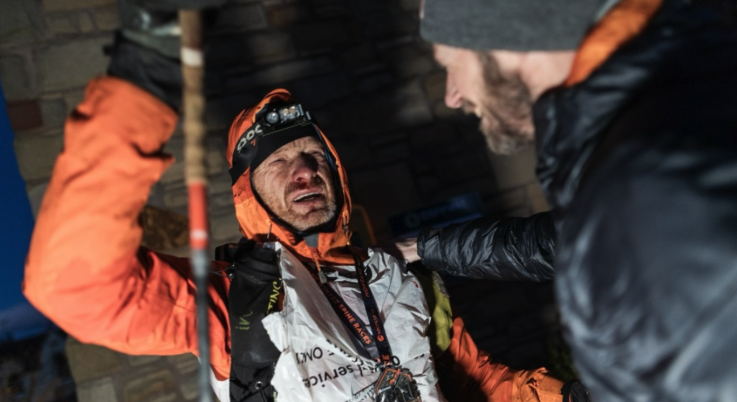
France’s Sébastien Raichon produced a measured and resilient performance to claim victory at the Montane Winter Spine Race, taking advantage of late drama to win what is widely regarded as Britain’s toughest ultramarathon.
This year’s edition of the race was notable even by Spine Race standards, with a remarkably high dropout rate as relentless winter conditions dismantled the field. Snow, ice and prolonged periods of cold, waterlogged terrain ensured that simply reaching the finish was a major achievement.
The 430-km journey along the Pennine Way, starting in Edale and finishing in Kirk Yetholm on the English–Scottish border, began at 8am on Sunday. From early on, it was clear that survival rather than speed would define the week.
Spain’s Eugeni Roselló Solé appeared to be mastering the conditions better than anyone else. By the third day he had built a commanding lead of more than 20 miles, moving smoothly while many rivals struggled or withdrew. Yet the Spine Race has a reputation for punishing even the strongest runners late on, and Wednesday evening brought a dramatic turning point.
Race organisers announced shortly after 9pm that Roselló Solé had withdrawn due to extreme exhaustion compounded by the cold, ending another painful chapter in his long and turbulent history with the event.
That opened the door for Raichon, who had been steadily closing the gap while racing with patience and restraint. Still around 10 miles behind at the time of Roselló Solé’s withdrawal, the Frenchman continued to progress through the night and ultimately crossed the finish line just before 8am on Thursday. His winning time was 95 hours, 43 minutes and 52 seconds — a remarkable achievement on his first appearance at the Winter Spine Race.
Britain’s James White finished second, around 15 miles behind, after maintaining a consistent effort through the latter stages.
Roselló Solé’s early dominance inevitably prompted caution among seasoned observers. Despite his undoubted talent, the Spaniard has endured repeated heartbreak at the Spine Race, having failed to finish 11 of the 12 editions since his victory in 2013 — including a memorable collapse just three miles from the line in 2019.
Raichon’s success was built on discipline rather than aggression. Race organisers praised his careful approach at checkpoints and his ability to learn quickly from those around him as more experienced competitors succumbed to the conditions. His decisive move came after CP5.5 at Byrness, where he pushed strongly through the final section.
At the finish, Raichon referenced the classic “Hare and the Tortoise” fable, explaining that a controlled strategy was essential for survival in such an unforgiving event. Known for major results in European ultra-distance races — including a recent victory at the Tour des Glaciers — he demonstrated his adaptability by mastering the Pennine Way’s winter extremes.
The brutal nature of the race was underlined by the early exit of American John Kelly, a former winner and Pennine Way fastest known time holder, who retired within the first 24 hours. Several other leading contenders followed.
James Nobles was prominent in the chase group into the third day before being withdrawn after showing signs of hypothermia and breathing difficulties, while fellow Brit James Leavesley also exited after more than 72 hours on the course.
At the time of writing only Raichon finished the race. Constant live updates here.