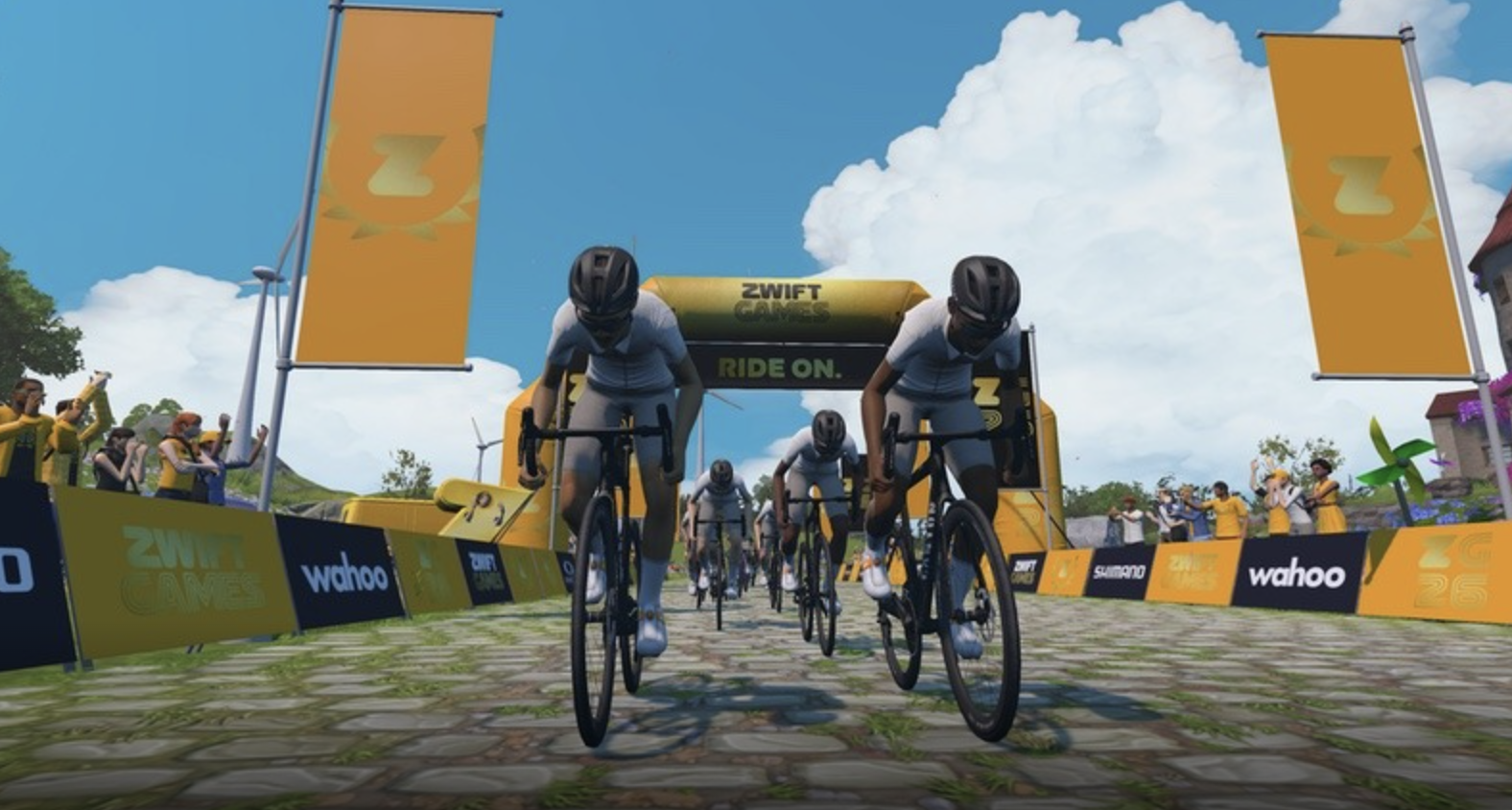

Zwift has confirmed the return of the Zwift Games for the 2026 season, with the global virtual racing series set to run from February 16 through March 29. Now firmly established as one of the platform’s headline competitive events, the Zwift Games continues to evolve – and this year brings new routes, a refined categorisation system, and an additional bonus stage designed to broaden participation.
For triathletes balancing early-season training with competitive intensity, the series offers a structured way to sharpen race fitness during the winter and early spring months.
Five New Routes, Progressive Challenge
The 2026 edition features five newly created race routes across Zwift’s virtual worlds. Each stage runs for one week, with the overall series designed to increase in difficulty as it progresses.
The featured routes are:
- Stage 1 – Kaze Kicker (Makuri Islands)
16.8km | 134m elevation - Stage 2 – Hudson Hustle (New York)
20.3km | 216m elevation - Stage 3 – Cobbled Crown (Richmond)
24km | 288m elevation - Stage 4 – Peaky Pavé (France)
30.6km | 368m elevation - Stage 5 – Three Step Sisters (Watopia)
37.8km | 587m elevation
The increasing distance and elevation gain mirror a progressive training load, making the series particularly relevant for triathletes building towards spring and summer race goals.
Racing Score System Replaces FTP Categories
In a continued shift away from traditional FTP-based categorisation, Zwift will once again use its Zwift Racing Score system. Riders are assigned a score between 1 and 1000 based on race performance, with the aim of creating more balanced and competitive fields.
Categories include Open, Advanced and Women-only options, offering accessible entry points while maintaining high-performance racing environments.
For triathletes accustomed to pacing by power metrics, the new system adds a performance-based competitive layer beyond pure threshold numbers.
New Bonus Stage: Crit or Time Trial
A new sixth “Bonus Stage” will run from March 23–29 and introduces two distinct race formats:
- Crit Cade (Crit City) — a gamified criterium featuring steering, power-ups and hazard pads.
- Epiloch TT (Scotland) — an 11.1km individual time trial against the clock.
While both formats have standalone rankings, results from the Bonus Stage do not count toward the overall General Classification (GC), which remains based on the five main stages.
For triathletes, the Epiloch TT in particular offers a focused opportunity to test sustained power – a valuable benchmark as race season approaches.
Performance Tracking and Power Metrics
Zwift will host a dedicated event website tracking overall GC standings and individual stage results. The platform also introduces Zwift Games Power Metrics, allowing riders to compare race outputs against their 90-day personal bests – a useful performance indicator for athletes monitoring fitness progression.
Road to Glory: Preparing New Racers
In the lead-up to the Games, Zwift will host “Road to Glory” guided group rides from February 9–20. These sessions target newer racers and cover fundamentals such as race dynamics, positioning, and strategic use of power-ups – an accessible entry point for triathletes less familiar with Zwift’s competitive environment.
Rewards and Partners
Official partners Shimano, Oakley and Wahoo return for 2026, with in-game unlockables awarded based on stage completion:
- Oakley Sphaera Strike Glasses – 1 stage
- Zwift Games 2026 Kit – 3 stages
- Oakley Velo Stelvio Helmet – 5 stages
- 6,000XP bonus – all 6 stages
A make-up week from March 30 to April 5 will allow riders to revisit the first five stages if they missed a race or wish to improve their GC standing.