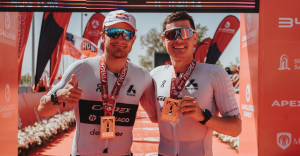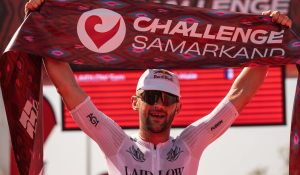
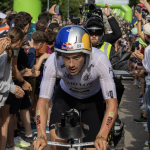
There may have been a few chuckles when Sam Laidlow announced the days before Challenge Roth that his goal today was to shave five to even ten minutes off the course record (7:23:24) – and thereby crush the world record (7:21:24) – but today, the defending champion backed up his words in otherworldly fashion. He completely outclassed all the top favorites, reducing them to mere background actors, and won the iconic race in the fastest time ever recorded. Laidlow just won Challenge Roth in a dizzying time of 7:21:04. In the final ten kilometers, a completely exhausted Laidlow lost several minutes against the world-record pace, but in the end, he still broke it by a margin of just a few seconds.
A Tactical Masterclass in the Water
The race burst into life right from the start. In the waters of the Main-Donau Canal, a five-man breakaway group formed immediately, consisting of Rico Bogen, Jonas Schomburg, Finn Grosse-Freese, Sam Laidlow, and Menno Koolhaas. While these men are all renowned as very strong swimmers, what followed was a refreshing dynamic: the group worked together seamlessly, regularly rotating the lead. Their mission was clear – leave top favorite Kristian Blummenfelt with as big a deficit as possible before the bike leg.
The strategy worked brilliantly. By the time the front five exited the water in T1 with a swim time of 46:56, Blummenfelt was already 2:58 minutes behind. He entered transition in sixth place, closely followed by Frederic Funk. Other heavy hitters, including Kristian Hogenhaug and Magnus Ditlev, trailed in a large chasing pack just over four minutes back.
Leaders Lay the Foundation for History
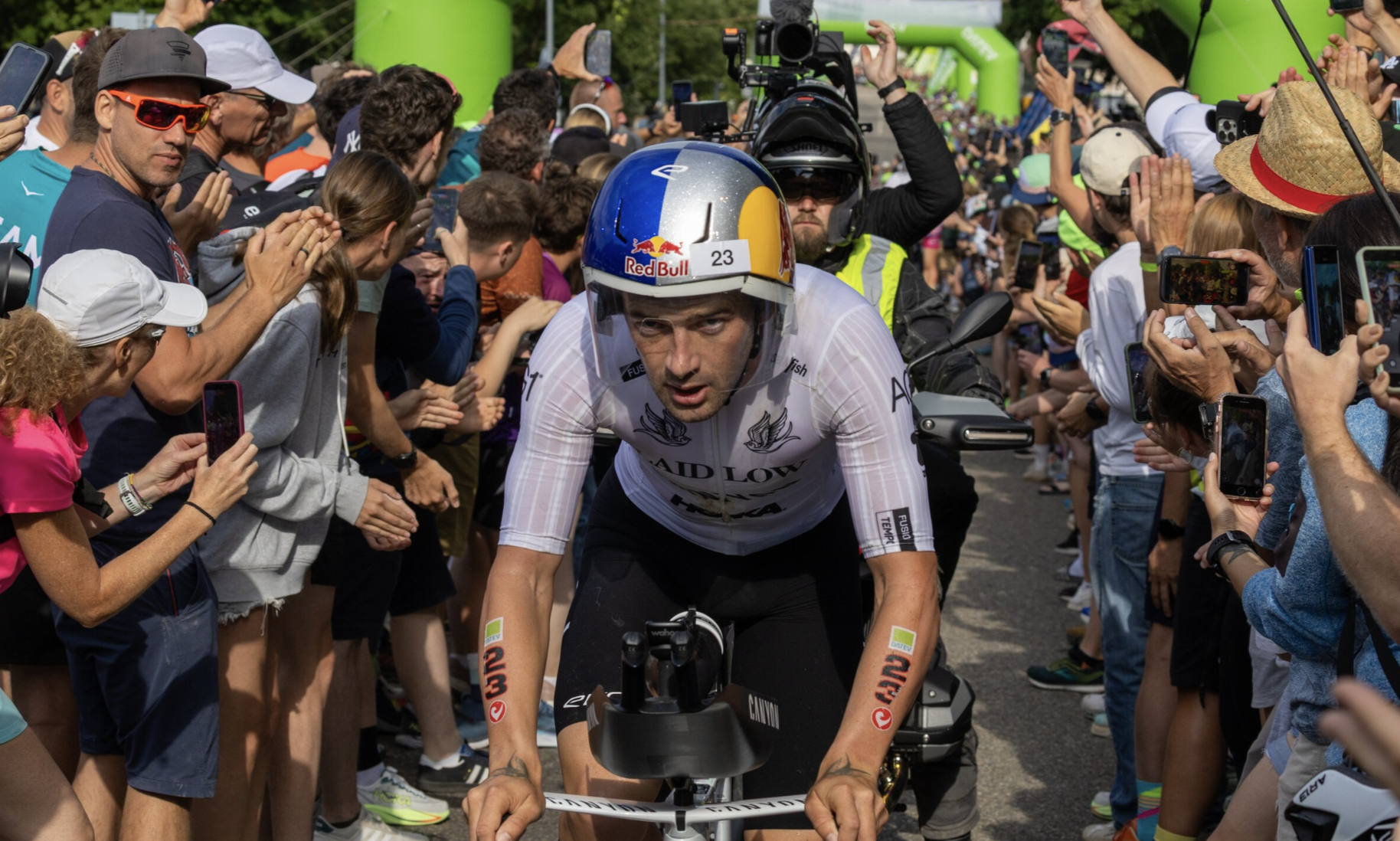
Once on the bike, Laidlow, Schomburg, and Bogen quickly dropped the other two breakaway companions. Within thirty kilometers, they had carved out a lead of over three minutes on Koolhaas and Grosse-Freese. Behind them, Ditlev and Blummenfelt began their charge forward. However, their efforts were in vain against the blistering pace at the front; though they managed to overtake Grosse-Freese and eventually Koolhaas, they couldn’t claw back any time on the leading trio. Meanwhile, Funk had faded from the chase, and Hogenhaug was unable to bridge the gap.
As the three leaders continued to extend their advantage, it became obvious they were on track for a historic bike split. The brutal, unrelenting pace eventually claimed its first victim around the 120-kilometer mark, when Schomburg was forced to drop off. The tempo never wavered, and ultimately, Bogen flew into T2 with a blazing new bike course record of 3:54:45, with Laidlow hot on his heels just one second later. Schomburg returned in third but had conceded nearly seven minutes, while Ditlev and Blummenfelt started the marathon a massive twelve minutes adrift. Koolhaas and Funk joined forces in the closing stages of the bike leg, starting their run over fifteen minutes behind the leaders.
Bogen Takes the Initiative, Laidlow Relies on Experience
Remarkably, it was the debutant Bogen – competing in his very first Full Distance race – who took the initiative in the opening kilometers of the run. Unfazed, Laidlow stuck to his own rhythm, trailing by just a few seconds. His experience and patience proved golden; after just two kilometers, he reeled Bogen back in, and the two ran side-by-side for the next ten kilometers.
As they ran along Challenge Roth’s infamous canal, there was little to separate them on paper, but their body language told a different story. Laidlow looked effortless, while Bogen’s face began to contort with effort. Sure enough, at the 12-kilometer mark, Bogen cracked, allowing a gap to form. From that moment on, Laidlow executed his race plan to perfection.
By the halfway mark, Laidlow could theoretically have cruised to a comfortable victory. His lead over Bogen had grown to two minutes, Schomburg was ten minutes back, and although Blummenfelt was clawing back two minutes and was about to pick up Schomburg, it was nowhere near enough to trouble the Frenchman. However, Laidlow was still running minutes ahead of the world-record pace. Driven by history, he kept pushing with everything he had, looking remarkably smooth in the process. Showing virtually no signs of fatigue, Laidlow ticked off the kilometers one by one, making the extraordinary look routine.
But then the final ten kilometers of the race began, and Laidlow suddenly hit the wall; during the grueling kilometers climbing up toward Büchenbach, his pace dropped completely, and once at the top, he even had to walk for a brief moment – if only for a few seconds. Completely exhausted, he lost minute after minute against the world-record schedule, while also watching Blummenfelt close the gap minute by minute. Meanwhile, with five kilometers to go, Blummenfelt overtook Bogen in the battle for second place, setting the stage for an incredibly tense finale.
Just short, just enough
In the final kilometers, Laidlow seemed to come up just short of the world record, but in the final meters, he found a sudden burst of life. A highly grueling but successful acceleration ultimately carried him to victory in a new world record: 7:21:04. Blummenfelt finished second in 7:26:24 and Bogen finished third in 7:27:53 – good for the fastest Long Distance debut ever.